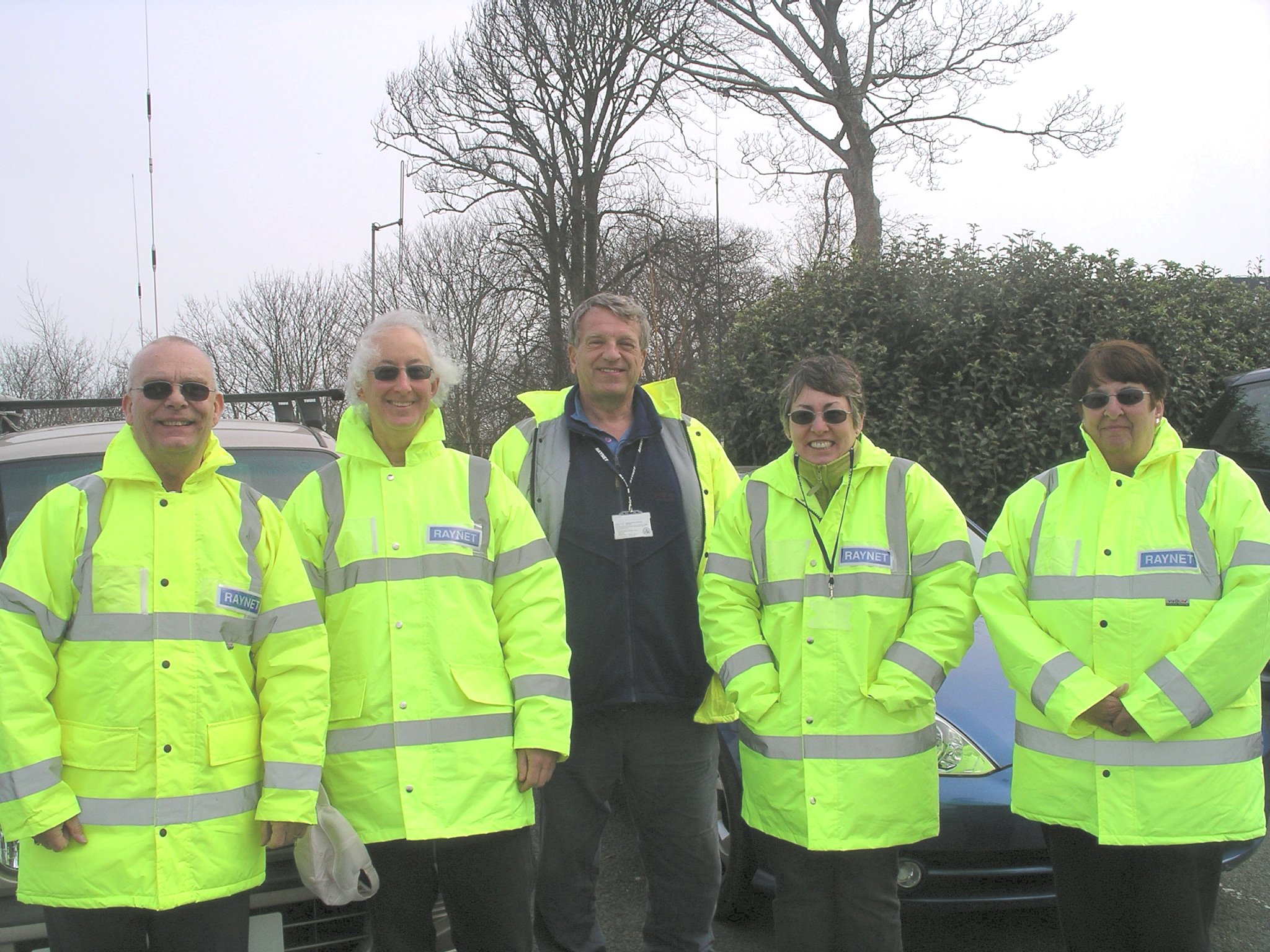
Koos GU0GUX, Derek GU3ZOM, Richard GU8FBO, Jane and Judy.
Picture by Mike GU3WHN
Exercise Quicksilver 2 - March 2007
“Send Three and fourpence, we’re going to a Dance.”
For those of us lucky or unlucky enough to have been involved in international
affairs it is recognised that the duty of any Nation/State is to survive.
This is equally true of us as individuals as it is of Guernsey as a society.
Which parent does not recognise instantly the hunger cry of their newborn
baby? What about the international image of the island as a finance centre?
At an individual level we utilise all of the 5 senses, whether
we realise it or not, to communicate. The more senses that we can bring
to bear, the better the quality of the information we receive, thus enabling
a greater chance of surviving the given situation.
The Armed Forces have a strategy based on Command, Control, Communications
and Intelligence. It might be thought of as a three-legged stool representing
the three C’s, with Intelligence being the foundation upon which the stool
sits. Imagine what would happen to the stool if one of the legs was dramatically
shortened….. Other models also add the important elements of Coordination,
Cooperation, Flexibility, Economy and Foresight, to name but a few.
What we regrettably all face is an ever increasing
personal threat, whether it is from acts of terrorism or a serious threat
to our health. The UK Government constantly publish their guidance on
what they consider to be the most important threats posed to us at the current
time. Their conclusions, based on comprehensive risk assessments, are to
be found in some detail on the UK Government Resilience website. Anybody visiting this site will see that the current High
Profile risks are Avian Influenza (Bird ‘Flu) and Human ‘Flu Pandemic. This
should come as no surprise. Further investigation of this site informs
us of the projected likely effects to us as a general population, should
one of these high risks become a reality.
One of the most likely early effects is that a substantial number of
key workers will become unavailable for work, placing the provision of
services normally taken for granted at serious risk. If we go back to
the model of the stool for a moment, and anticipating a dramatic reduction
in, say, the provision of power, it is fairly clear that the stool is likely
to fall over unless plans are in hand to deal with the likely outcomes.
It is reassuring that comprehensive plans are already in place across
the nation and the key word is Resilience, perhaps easily described as the
ability to survive.
One leg of the notional stool mentioned earlier deals with the instinctive
act of survival, namely that of effective communication.
Many volunteer groups are training with Government organisations and
preparing themselves to assist the population at large, should the risks
become a reality. One of these groups is RAYNET, the Radio Amateurs’ Emergency
Network. RAYNET is the UK’s national voluntary
communications service provided for the community by licensed radio amateurs.
The word amateur is misleading. Radio Amateurs range from cutting-edge
scientists from many disciplines to young people who pass the first examination
of three on their progressive journey to becoming a fully qualified radio
amateur. HRH The Duke of Edinburgh is the Patron of the Radio Society
of Great Britain, the organisation to which a large number of radio amateurs
belong.
The Radio Amateurs’ Emergency Network (RAYNET) was formed in 1953 following
the East Coast floods, when radio amateurs provided emergency communications.
It is a Registered Charity and is used extensively by agencies throughout
the UK to assist in the provision of emergency communications. As a recent
example of RAYNET involvement, an East Anglian Group was called out in
March this year, 54 years on, to assist the emergency services during severe
weather conditions which threatened severe flooding and potential loss of
life. The calls for assistance are many and varied throughout the UK and
RAYNET is a regular presence in Local Government Resilience planning meetings
and also those at a national level.
The Bailiwick of Guernsey Group was re-formed on the 1st of
October, 2006. It was the result of a year’s development between the Group
and the States of Guernsey Emergency Planning Officer. You may well have
seen vehicles being driven around the island’s roads, boasting the RAYNET
stickers. You may also have seen an array of aerials at Beau Sejour during
the recent Resilience exercises, code-named Quicksilver.
The local Group is a part of the National RAYNET organisation and is
a member of Zone 7, the South West Region. Members pay a small membership
fee and have to undergo Police investigations as to their suitability to
be entrusted with what could amount to considerable responsibilities, all
on behalf of the local community at large. The Group Controller has attended
a number of UK Local Government meetings and the Bailiwick of Guernsey
Group has been incorporated into the Resilience plans of the Government
Office of the South West, based in Bristol. They in turn answer to the
Cabinet Office. Two exercises have been held to date, one in November
last year and one in March. A key element of the local exercises has been
to test and establish communication paths back to the UK elements of the
Zone. This was achieved on both occasions. Other aspects of the exercises
included the successful logging of signals between sites across the length
and breadth of the island. The other islands have not been forgotten………..
We are, of course, a very small part in the grand scheme of things.
Please say “Hello” if you see us out and about. Oh, yes, “Send Three
and fourpence, we’re off to a Dance” alludes to a message said to have
been sent through many channels from the Front during the First Word War.
It should have read “Send reinforcements, we’re going to advance.”
Resilient, effective communications are one vital key to survival!
Search for RAYNET on the web or use the link on the home page. Bye for
now…………..
GU3WHN - Controller, Bailiwick of Guernsey Group - April, 2007